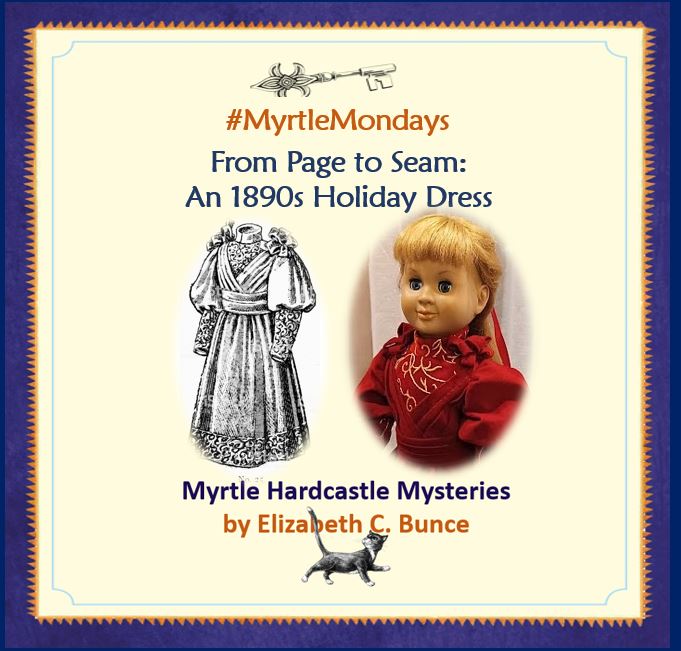
 Since I don’t actually have a girl Myrtle’s age on hand, I have recruited some 18″ dolls to work as fit models. The model for this particular gown is Georgie, a vintage 1993 Battat Our Generation doll (don’t tell anyone, but she kind of reminds me of Myrtle’s neighbor, LaRue Spence-Hastings). Shortly after I began doll costuming, I stumbled across this image of an 1893 “Holiday Gown” for girls, and was instantly smitten:

From The Family Friends of 1893
Since Cold-Blooded Myrtle (Myrtle Hardcastle Mysteries #3) is set during the Christmas season of 1893, I simply had to recreate this very special dress! I loved everything about it, from the contrast cuffs, hem, and underbodice, to the pleated overlays and sash, to the magnificent puffed sleeves (so characteristically 1890s!), to those totally bonkers bows on the shoulders.


Guaranteed to get caught in your hair, your earrings, your headgear, and probably your carriage door.
I instantly set about work on the longest, most arduous, and most critical aspect of the project: finding two coordinating fabrics. They needed to drape well in doll size (1:3 scale), while still making nice puffs and gathers, and they had to match in both color/print/design and weight.

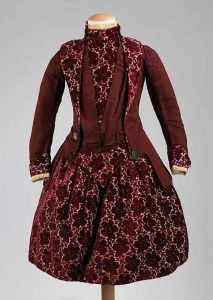
A real tone-on-tone young teen’s dress from the 1880s. This one appears to be cut velvet and silk faille.
This was not as easy as you might suppose (particularly since much of this Windows shopping took place during the pandemic, when my in-person shopping was limited.). I therefore now have a hearty collection of small cuts of lovely fabrics that do not coordinate with anything. Ahem.


Some prospects that didn’t pan out…
…And then, after almost two years of fruitless searching, I stumbled into the Perfect Fabrics, right here at home! Many moons ago, I made this Christmas tree skirt, from a scroll-print red velveteen that had been a gift from my husband. It’s been packed away for several Christmases, however, until C.J. decided it was a good time to bring it out again.


Was it possible I Knew All Along, and that’s why the other choices never looked right?!
Just at the same time, I happened to be pre-washing a handful of small cuts of red fabric, including about a yard of very fine-wale scarlet red corduroy that I have no memory of buying (what did I think I would do with just a yard?). I walked past the Christmas tree skirt, corduroy in hand, and the heavens broke open and the Sewing Angels sang! The reds matched *perfectly.* The fine texture of the corduroy made it look like a plain version of the scrolly velvet. The scrolly velvet looked fabulously festive and Victorian. I had The Fabrics!!
…If I could only track down the decade-old scraps from the tree skirt. I never throw anything useable away, so I knew they were here… somewhere, but I did not know if they would be large enough. Fortunately, I keep my fabric stash pretty well semi-organized, so a couple of days of scrounging led me to the right scrap bin—and hallelujah, I found two large-ish offcuts (which is what you get when you cut a rectangular piece of fabric into the largest circle possible).


Those gorgeous gold scrolls are actually some kind of plasticky puff paint…
Now, this fabric would have been even *more* ideal in human scale, as it would have shown off more of the scroll design on the velvet. Still, I was hardly going to let a little thing like that discourage me!
Armed with my fabric, a good supply of muslin, a nice set of potential patterns to work from, a patient fit model, and lots of pins and scrap paper, I set to work! I knew I would need to address the following parts of the gown:
- The pleated surplice bodice overlays
- The underbodice with the high collar
- The bell-shaped puffed sleeves with
- Tight contrast lower sleeves
- The full skirt with contrast hem
- The pleated sash and
- The Shoulder Bows!
All of these elements also needed consideration for how they would be finished (hems, etc), particularly as the scrolly velveteen was not amenable to aggressive pressing.
The patterns I chose to work with were:
Little Miss Muffett’s “Edwardian Fall”
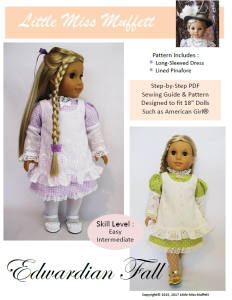
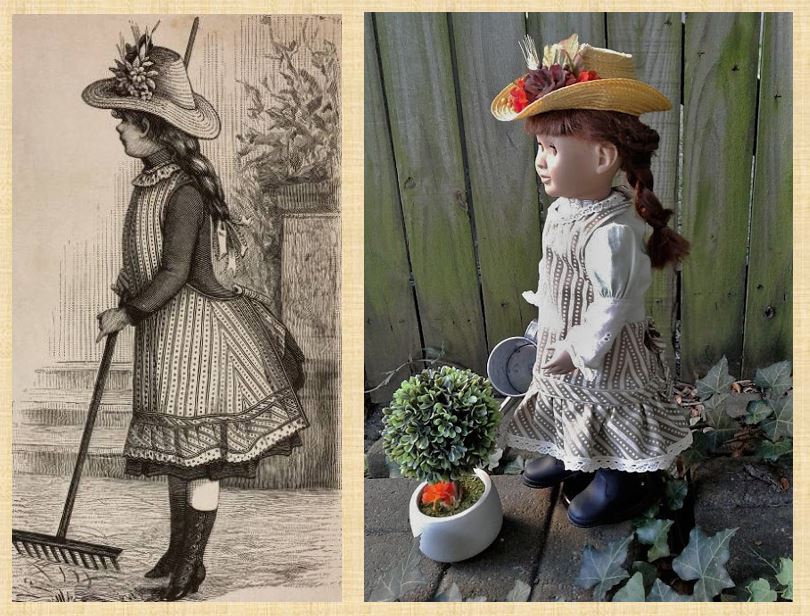
I’ve used this pattern (which includes a dress and a pinafore) several times, including this spring ensemble and these 1890s gardening togs. It fits my dolls well and the component parts were nicely adaptable for this project. For this gown, I used the dress pattern for the gown bodice (shortening it to the waist and adding a band collar) and the two-part sleeve: vastly increasing the volume of the upper sleeve by slashing and spreading the pattern piece so it resembled a massive bell. In the photo above, Georgie is wearing one of those early mockups, over top of her original soft green linen version. Two and a half mockups later, I had a sleeve that looked right.
Lee & Pearl Classic Wrap Dress/Top

This was the only surplice/wrap front bodice I could find for 18″ dolls, and even its beautiful pleats weren’t quite right. I could probably have gone with them as is, and been happy with it—but after taking so long to find the perfect fabric, dangit, my surplice was going to be a perfect, exacting reproduction of the original!
…Enter some slashing & spreading. On the left is the original L&P wrap bodice pattern (cut from muslin), and one with the pleats pressed in. And on the right is my modified version. These are the very first pleats I have ever drafted, and they worked brilliantly!
…After all of that, who would have thought that the skirt would have been the biggest drafting challenge?


Dolls are very patient clients…
Three of the many mockups I made. My first idea was to use the full-but-not-too-full skirt from KwikSew 2921, which I’ve sewn before. As soon as I made the initial mockup, however, I realized the problem: that skirt (slightly gored) has a curved hemline. In order to maximize my limited supply of gold scrolly velvet, I planned to simply cut a straight band for the hem. Straight bands and curved hems do not really play well together (I did try, just in case. LOL). I kept getting versions where the skirt felt too full, instead of the soft, slight A-line of the fashion plate.
Insert philosophical note about how fashion illustrations seldom represent the actual real-life behavior of real-life fabric, and that often what you see in a drawing may not be reproducible in real life.
…Nevertheless. Never try to explain things logically to an obsessed historical costumer!
Ultimately, I decided on a simple straight panel of moderate fullness (twice the waist measurement), with the straight hem band.
With the mockups and drafting done, it was time to sew!
And, naturally, my perfectly perfect coordinating fabrics, which were clearly Meant to Be… did not want to be sewn together. And they really didn’t want to be sewn together with the lining/facing fabric (a lightweight, very slippery gold satin that frayed like its life depended on it, spitting off plumes of fine sparkly gossamer across every surface of my sewing room, my clothes, my face, my cats… Ahem.)
To construct the contrast hem and sleeves, I layered the gold velvet with the facing fabrics right sides together and sewed a narrow seam which became the bottom “hem” edge. Then I serged the whole faced panel to the velvet skirt and sleeves, nicely finishing all raw edges and not requiring any hand finishing. The tight lower sleeves were achieved with a combination of removing ease from the sleeve pattern and adding a tiny snap at the wrist to snug up the fit.
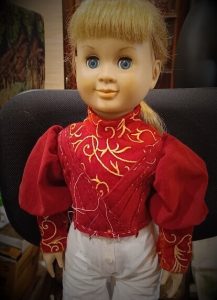

The bodice in progress–so much basting to keep those pleats from shifting!
The final touches were the pleated sash and the shoulder bows. Enter more basting…

Not actually a bowtie. In the back are the bias tubes I made for the shoulder bows (bias strips sewn into a tube then turned right-side-out and *carefully* steamed flat.)
The sash is a rectangle of corduroy the length of Georgie’s waist measurement + seam allowances and overlap for a snap closure, with three horizontal knife pleats. It’s sewn right sides together with a backing fabric, then turned and pressed.
Add a Giant Bow…
I used red pearl snaps for the back closure–an elegant if not-quite-period-accurate touch. (Buttonholes and I Do Not Get Along.)


At long last, and a few months overdue, Georgie is ready to attend a posh holiday soiree!
I am positively delighted with how this gown has come together! Sometimes projects take on a life of their own and evolve beyond the original brief, but this one looks absolutely just as I imagined it! Straight from the pages of The Family Friends of 1893, we have a lovely girl’s frock of red velvet, with puffed sleeves, sash, and back snap closure.


Oh, wait–we didn’t talk about The Bows, did we? They are simply sections of the bias tubes sewn into loops, then stacked together. A few sturdy hand-stitches keep them secure and mostly under control.

Agatha Awards, here I come! (The pleats on Georgie’s bodice came in handy here, too.)

Oh, and that’s not the only fancy red dress I made recently… 😉
I am now disappearing back into the Sewing and Writing Cave, wrapping up the first draft of Myrtle Hardcastle Book 5, Myrtle, Means, and Opportunity (fall 2023) and working on my own posh party frock for the Edgar Awards next month! But I have some Incredibly Exciting Doll News to share soon, which will of course mean more new doll costumes. Stay tuned!





 Flint and Ladygirl were our pack leaders, so it only seemed right for them to star in the new book! Flint (right) became Cleveland, and Ladygirl (left) became Minna.


 One of the most distinctive and recognizable elements of Scottish culture is the wearing of clan tartans: displaying your individual family heritage with a specific plaid pattern. But people are often surprised to learn that this tradition is a relatively recent one, which came into its own in the Victorian era. Let’s take a look at the colorful history of tartan!


 You would have no reason to know this (and so you are forgiven for not sending a card), but today is Myrtle Hardcastle’s birthday! In addition to being her her actual calendar birthday, according to information in Myrtle Hardcastle Mysteries #2,


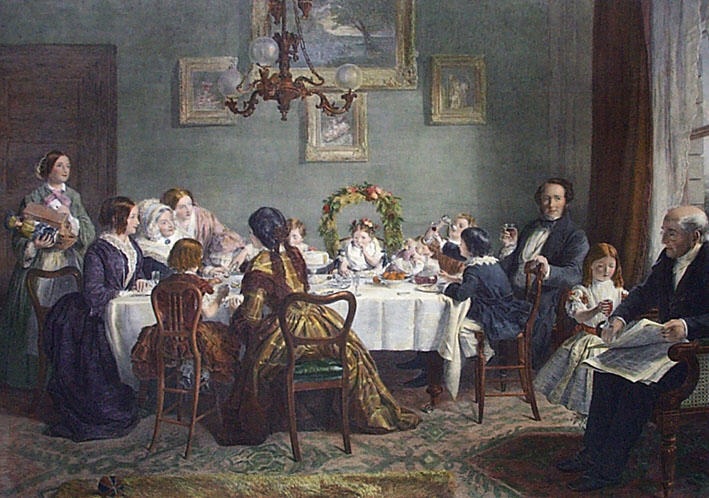


 It’s a little Historical Costuming Side Trip! I’ve shared



Natalie Aguirre
Judith Bunce
J. Hyde